

How to Build a Monthly Blog Plan for a Local Business Without Repeating Topics
A monthly blog plan for a local business works best when it gives readers several useful ways to understand your services, rather than returning to the same broad topic over and over. A business may have only a handful of core services, but every service creates many distinct questions: what it includes, when it is needed, how it compares with an alternative, how a customer can prepare, and how seasonal conditions affect the decision.
The goal is not to invent endless topics. It is to organize the topics you already have so each article has a clear job. This approach makes your calendar easier to maintain, gives readers more useful information, and helps you avoid a blog filled with slight variations of the same service page.
Start with the questions behind each service
Before planning a month of posts, list your main services or products. For each one, write down the questions a prospective customer may ask before choosing it, along with questions they may have after they have started researching.
Useful question categories include:
- Understanding: What is this service? What does it normally involve?
- Choosing: Is this the right option for my situation? How does it differ from another service?
- Preparing: What should I do before an appointment, installation, consultation, or purchase?
- Timing: When should I think about this service? Is there a seasonal consideration?
- Maintaining: What can I do between visits or after a project is complete?
This is more useful than starting with a keyword list alone. A keyword may tell you the words someone uses, but the underlying question tells you what the article needs to explain. If two proposed posts answer the same question in nearly the same way, combine them or choose a different angle.
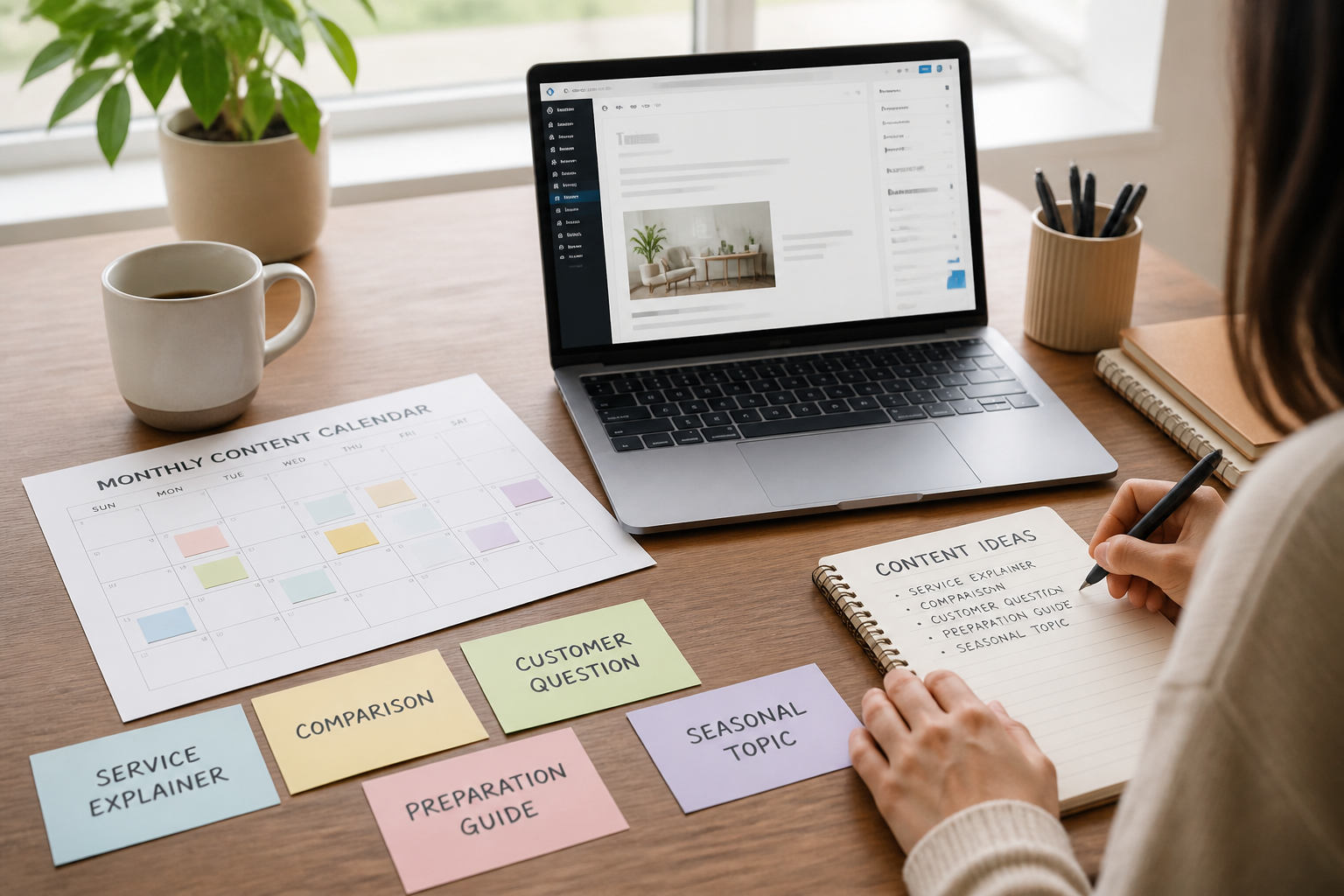
A five-part monthly blog plan for a local business
For a simple, balanced calendar, publish one article from each of these five categories during the month. If you publish less often, rotate through the categories instead of trying to fit every one into four weeks. If you publish more often, use the framework as a foundation and add narrowly focused follow-up posts where they genuinely help.
| Content type | What it helps a reader do | Example angle |
|---|---|---|
| Service explainer | Understand one service clearly | What is included in [service], and when might you need it? |
| Comparison | Choose between related options | [Service A] vs. [Service B]: how to decide |
| Customer question | Get a direct answer to a common concern | How long does [process] usually take to prepare for? |
| Preparation guide | Know what to do before a service or purchase | How to prepare for your [service] appointment |
| Seasonal or timely topic | Plan around a relevant time of year or recurring need | What to check before the busy [season] begins |
The same service can appear in more than one category without becoming repetitive because the reader’s task changes. A service explainer might define the work and its purpose. A preparation guide focuses on what the customer should do beforehand. A comparison helps someone weigh alternatives. Each post should lead with its specific question, not with a generic overview of your business.
Week 1: Publish a service explainer
Service explainers are the foundation of a useful business blog. Choose one focused service or product, then explain its purpose, common situations where it may be relevant, the broad steps involved, and any decisions a customer may need to make. Keep the scope tight. An article about every service you provide is usually too broad to answer a reader’s question well.
For example, instead of writing “Our Complete Services,” choose an article such as “What happens during a [specific service]?” The article can link naturally to the relevant service page if one exists on your site. It should not try to replace that page. Think of the blog post as helpful context and the service page as the place where readers can find your core offering.
Week 2: Publish a fair comparison
Comparison topics are valuable because many readers are deciding between two legitimate choices. Compare related services, materials, appointment types, maintenance approaches, or timing options. Explain what each option is intended to do, who might prefer it, and what questions can help someone make a choice.
A useful comparison does not need to declare one option universally better. In many cases, the honest answer is that the right choice depends on the customer’s goals, condition, budget, timing, or preferences. That nuance makes the article more credible and prevents it from becoming a disguised sales pitch.
To avoid overlap, do not publish multiple comparisons that use the same decision criteria in consecutive months. If one post compares two services, the next comparison might focus on timing, upkeep, or a different stage of the customer’s decision.
Week 3: Answer one customer question
Customer-question articles should be specific enough to answer in one sitting. Good starting points include questions you hear in consultations, messages, calls, or conversations with customers. You can also review the questions that come up repeatedly when people are deciding whether a service is relevant to them.
Use the question as the title or close to it, then give the answer early. Follow with the context that helps the reader understand why the answer can vary. Avoid stretching a short answer into a long article by adding unrelated sections. A concise, complete answer is more useful than a broad article that never gets to the point.
Week 4: Publish a preparation or seasonal guide
Preparation guides help readers feel informed before they take the next step. Depending on your work, that could mean explaining what information to gather, what area to clear, what to photograph, what questions to consider, or how to plan for a visit. Only include instructions that are accurate for your own process. If a step varies by situation, say so rather than presenting it as a universal rule.
Seasonal content can serve the same planning purpose. The season should be meaningful to the service, the customer’s needs, or a recurring cycle in the industry. A seasonal post does not have to mention a holiday or a weather event to be timely. It can cover planning ahead for a busy period, maintaining something between seasons, or reviewing an annual need before it becomes urgent.
Use a topic matrix before filling your calendar
A topic matrix is a simple way to see whether your plan is balanced. Put your services across the top of a spreadsheet and your content types down the side. Then add one possible article idea in each relevant cell.
| Content type | Service or product 1 | Service or product 2 | Service or product 3 |
|---|---|---|---|
| Explainer | What it is and when it helps | What the process involves | Key options to consider |
| Comparison | Option A vs. Option B | Timing comparison | Approach comparison |
| Customer question | Common concern | Common concern | Common concern |
| Preparation | Before the service | Before the service | Before the service |
| Seasonal | Relevant annual timing | Relevant annual timing | Relevant annual timing |
Not every cell needs an idea. Some services will not have a useful seasonal angle, and forcing one creates thin content. The matrix is a planning aid, not a quota. Its value is in showing gaps, overused services, and opportunities to explain a topic from a new perspective.
Check for repetition before you write
Before approving an idea, compare it with your existing posts and service pages. Ask four quick questions:
- What exact question will this article answer?
- Which service, choice, or stage of the customer journey does it cover?
- What will a reader learn here that they cannot already learn from an existing post?
- Can the title make that difference clear?
If you cannot describe the difference in one sentence, the topic may be too close to something you have already published. Rather than changing a few words in the title, shift the article’s purpose. A post about the benefits of a service can become a preparation checklist, a comparison, a troubleshooting guide, or an answer to a specific concern, provided you can support the new angle with useful information.
Keep a basic content inventory with the title, publication date, primary service, content type, season or timing, and main question answered. Over time, this becomes your best defense against accidental duplication. It also makes it easier to refresh a strong older article when information changes instead of creating another near-identical post.
Leave room for real business priorities
A content calendar should be structured, but it should not be rigid. New services, recurring customer questions, changes to your process, and seasonal timing may make a planned topic less useful than a new one. Review the next month’s plan before the month begins and replace ideas that no longer serve readers.
At Gordon, we help businesses turn their own services, locations, calls to action, and writing preferences into polished, WordPress-ready articles. You can provide your details once, choose a topic, then review and edit the article before publishing it. Learn more about how Gordon works, or see the available plans.
A monthly plan does not need dozens of ideas to be effective. A small rotation of clear service explainers, comparisons, customer questions, preparation guides, and timely topics can create a useful publishing rhythm while giving each article a distinct reason to exist.
Frequently asked questions
How many blog posts should a local business plan each month?
Plan a number you can review and publish consistently. Four posts per month works well with the five-part framework because you can rotate the remaining category into the next month. Publishing less often is also practical when each article answers a genuine customer question.
Can one service appear in multiple blog posts?
Yes. The key is to give each post a different purpose. One article can explain the service, another can compare it with an alternative, and another can help readers prepare for it.
What should I do if I run out of seasonal topics?
Do not force seasonal angles. Use a service explainer, comparison, customer question, or preparation guide instead. Seasonal content is most useful when timing changes what a reader needs to know.